
Cyanotoxins can be produced by planktonic and benthic cyanobacteria. Because the cyanotoxin classes produced by both planktonic and benthic cyanobacteria are overlapping, information presented in this section applies to both planktonic and benthic HCBs. This section covers cyanotoxin exposure routes, health impacts, classes of cyanotoxins, distribution in the environment, and toxicity thresholds. If you want to navigate directly to cyanotoxin thresholds for humans or domestic animals, you can simply click on the appropriate image on Figure 2-1.
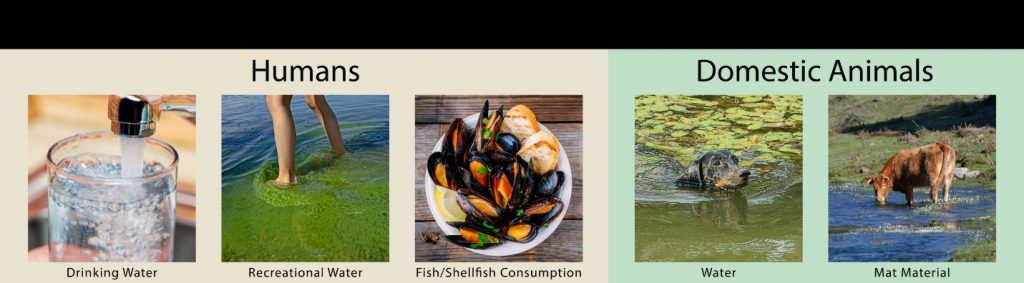
Figure 2‑1. Cyanotoxin Thresholds.
2.1 Exposure Routes to Cyanotoxins
Exposure to cyanotoxins can occur by ingestion, inhalation, or direct exposure to the skin. The most common routes of exposure are ingestion of water containing cyanotoxins or toxin-containing cyanobacteria cells, either through drinking water or recreational activity in water. Swimming, playing sports, or boating on water containing cyanotoxins or cyanobacteria can result in exposure via ingestion, inhalation of mists, or direct contact. Pieces of benthic algal mats are sometimes present in the water column, and ingestion of these mat pieces can also be a source of exposure. Consumption of fish or other foods from contaminated water might also result in exposure. The concentration of cyanotoxins in the water or biomass and the length of time of the exposure can influence the type and severity of any resulting health effects.
2.2 Health Impacts of Cyanotoxins
Case studies have examined reports of human and animal illnesses related to cyanotoxin exposure, and the Centers for Disease Control and Prevention (CDC) is now tracking those reports. Information about the CDC program is available from Harmful Algal Blooms–Associated Illness site (CDC 2021b). The information below relates to cyanotoxin exposure in general and does not necessarily pertain only to benthic HCBs. The cyanotoxins reported most often in the above incidents were microcystins followed by anatoxin-a (Roberts et al. 2020).
2.2.1 Effects of Cyanotoxins on Human Health
Information about adverse human health effects related to cyanotoxin exposure, particularly for benthic HCBs, is limited. There have been no human deaths confirmed due to recreational exposure to cyanotoxins in freshwater, but there have been illness outbreaks. For example, in the United States between 2016 and 2018, the CDC reports that there were 389 human health cases associated with 73 HCBs recorded in 18 states, with 51% of these cases related to one-time exposures at a lake in Utah (Roberts et al. 2020). The most commonly reported symptoms were gastrointestinal (67%), lethargy (43%), and dermatological (27%), as well as reports of headache and fever (Roberts et al. 2020). Nearly 40% of the human illnesses reported occurred in children under age 18. The majority of reports were received from June to September (Roberts et al. 2020).
2.2.2 Effects of Cyanotoxins on Animals
Illnesses and deaths of animals have also been reported, especially in dogs (Backer et al. 2013) and in livestock (Dreher et al. 2019). In 42 HCB events in 18 U.S. states during 2016 to 2018, there were 369 animal deaths reported among 413 cases of animal illnesses (Roberts et al. 2020). Of these, 52 of the illnesses were companion animals, including 50 dogs (Roberts et al. 2020).
2.2.3 Effects of Cyanotoxins on Aquatic Life
Wood et al. (2020) reported that few studies have looked at the effects of cyanotoxins on benthic organisms. These studies looked at extracts of microcystin and anatoxin-a from planktonic cyanobacteria on the sediment-dwelling midge Chironomus and found that the extracts were more toxic than purified cyanotoxins. The conclusion based on the study by Toporowska and Pawlik-Skowrońska (2014) was that compounds produced by cyanobacteria are likely to have a negative effect on some aquatic organisms. Anderson et al. (2018) showed that crude extracts containing anatoxin-a from the benthic cyanobacteria Phormidium showed significant mortality in both benthic organisms (midges and amphipods) and the planktonic organism Ceriodaphnia dubia. Most of the current aquatic ecotoxicity information is based on acute, short-term exposures to microcystins with more limited information on other cyanotoxin classes (Mehinto et al. 2021).
Bioaccumulation of cyanotoxins in aquatic organisms has been observed, particularly for microcystins (Chorus and Welker 2021). Banerjee et al. (2021) conducted a review of cyanotoxin effects on teleost fish and noted the evidence of bioaccumulation of cyanotoxins in fish species. Kelly et al. (2020) showed that high concentrations of purified anatoxin-a accumulated in a mayfly. They suggested that the possibility of trophic transfer of anatoxins should be investigated. Wood, Phillips, et al. (2012) found that nodularin from benthic mats accumulates in the hepatopancreas and tail tissue of the crayfish. Colas, Duval, and Marie (2019) found that fish collected from French rivers during benthic cyanobacterial blooms had anatoxins in their muscle, gut, and encephalon.
Cyanobacteria exhibit defense strategies to reduce grazing by aquatic organisms (such as zooplankton and macroinvertebrates). In a review of grazing resistance, Lürling (2021) presented instances of cyanobacteria forming large colonies (such as Microcystis) and flakes or bundles of filaments (like Aphanizomenon) that impede grazing or exceed critical dimensions to be consumed. In addition to poor palatability and grazing inhibition, cyanobacteria are of lower nutritional value and potentially toxic to zooplankton, which ultimately reduce vitality rates (such as lower growth and reproduction or increased mortality) of consumers (Moustaka-Gouni and Sommer 2020). Some unpublished information indicates that filamentous cyanobacteria may impede mayfly survival due to either interference with food uptake or physical effects on its ability to live in filamentous cyanobacteria (James Lazorchak, personal communication).
1.3 Overview of Cyanotoxin Classes
Cyanotoxins are secondary metabolites produced by cyanobacteria that could result in adverse health effects in humans, animals, and other aquatic life after exposure through ingestion, inhalation, or contact with water or biomass containing the cyanotoxins. The concentration and potency of cyanotoxins at the time of exposure can influence the extent of the toxic effect.
A summary of the types of cyanotoxins is presented in Table 2-1 below and in Table 3.1 of HCB-1 (ITRC 2021) [LINK]. Cyanotoxins are typically grouped by their dominant target of toxicity in humans and animals as shown in Table 2-1. Concentrations of chemicals that act by the same mode of action are typically summed (assuming additive toxicity) and the overall total is compared to the appropriate threshold. If sufficient information is available to develop toxicity equivalency factors (TEFs) for individual structural variants relative to a reference chemical, then each individual structural variant would be multiplied by that TEF and the sum of overall cyanotoxin equivalents would be compared to the threshold. More details are provided for each cyanotoxin class below.
Table 2‑1. Human and animal health impacts from cyanotoxins and compoundsSource: Adapted in part from Sanseverino et al. (2016) and (Fiore et al. 2020)
| Compound Classification | Cyanotoxin*/Irritant | Main Target Organ | Effects |
| Hepatotoxins | Microcystin | Liver | Diarrhea, vomiting, weakness, liver inflammation, liver hemorrhage, pneumonia, dermatitis |
| Nodularin | Liver | Diarrhea, vomiting, weakness, liver inflammation, liver hemorrhage, pneumonia, dermatitis | |
| Cylindrospermopsin | Liver and kidney | Diarrhea, vomiting, nausea, gastroenteritis, liver inflammation, liver hemorrhage, pneumonia, dermatitis, kidney damage, headache | |
| Neurotoxins | Anatoxin-a | Nervous system | Muscle twitching, burning, numbness, drowsiness, salivation, respiratory paralysis leading to death |
| Guanitoxin -formerly anatoxin-a(S) | Nervous system | Salivation, convulsions, muscle fatigue, and respiratory arrest | |
| Saxitoxins | Nervous system | Muscle twitching, burning, numbness, drowsiness, headache, vertigo, respiratory paralysis leading to death | |
| Β-methylamino-L-alanine (BMAA) | Nervous system | Chronic exposure associated with neurodegenerative disease reported by some studies; scientific discussion is ongoing | |
| Aetokthonotoxin | Nervous system | Avian vacuolar myelinopathy | |
| Dermatoxins and Skin-Irritating Compounds | Aplysiatoxin | Skin | Skin irritation, upper respiratory irritation |
| Lyngbyatoxin | Skin | Skin and eye irritation, respiratory problems | |
| Lipopolysaccharide | Skin | Skin and eye irritation, headache, allergy, upper respiratory irritation, fever |